-
Overview
Claude Monet was so taken with Barbier's works that he sponsored an exhibition of his works with a preface by Monet's biographer and friend, Gustave Geffroy, who urged him to "build of mist and light, a world of poetry"
André Barbier (1883-1970) was born in Arras, France into a family of lawyers. At the age of twenty, Barbier settled in Paris at the Quai aux Fleurs, and in the same year, 1903, he began exhibiting landscapes and still lifes at the Paris Salons. Inspired by his Impressionist forbears, Gustave Courbet, Claude Monet and Camille Corot, Barbier delighted in depicting verdant forests and luminous seascapes at different times of the day and in a variety of atmospheric conditions. Like many of his contemporaries in early nineteenth-century Paris, Barbier travelled extensively in pursuit of subjects for his landscapes. Barbier chose to capture scenes of the Normandy coast and the French Riviera and also travelled further afield to Italy.
Although a follower of the Impressionists, Barbier’s style is wholeheartedly distinct. Barbier built up compositions using delicate layers of paint in a post-impressionist manner, often using a flickering outline to the forms within the landscape and imbuing his compositions with a delicate haze of light. Due to his wealth, much of Barbier's work has remained with his family, but today his paintings are collected extensively in America and Europe and have recently been bought by members of the Monaco and Belgian Royal families.
-
Works

André Barbier French, 1883-1970
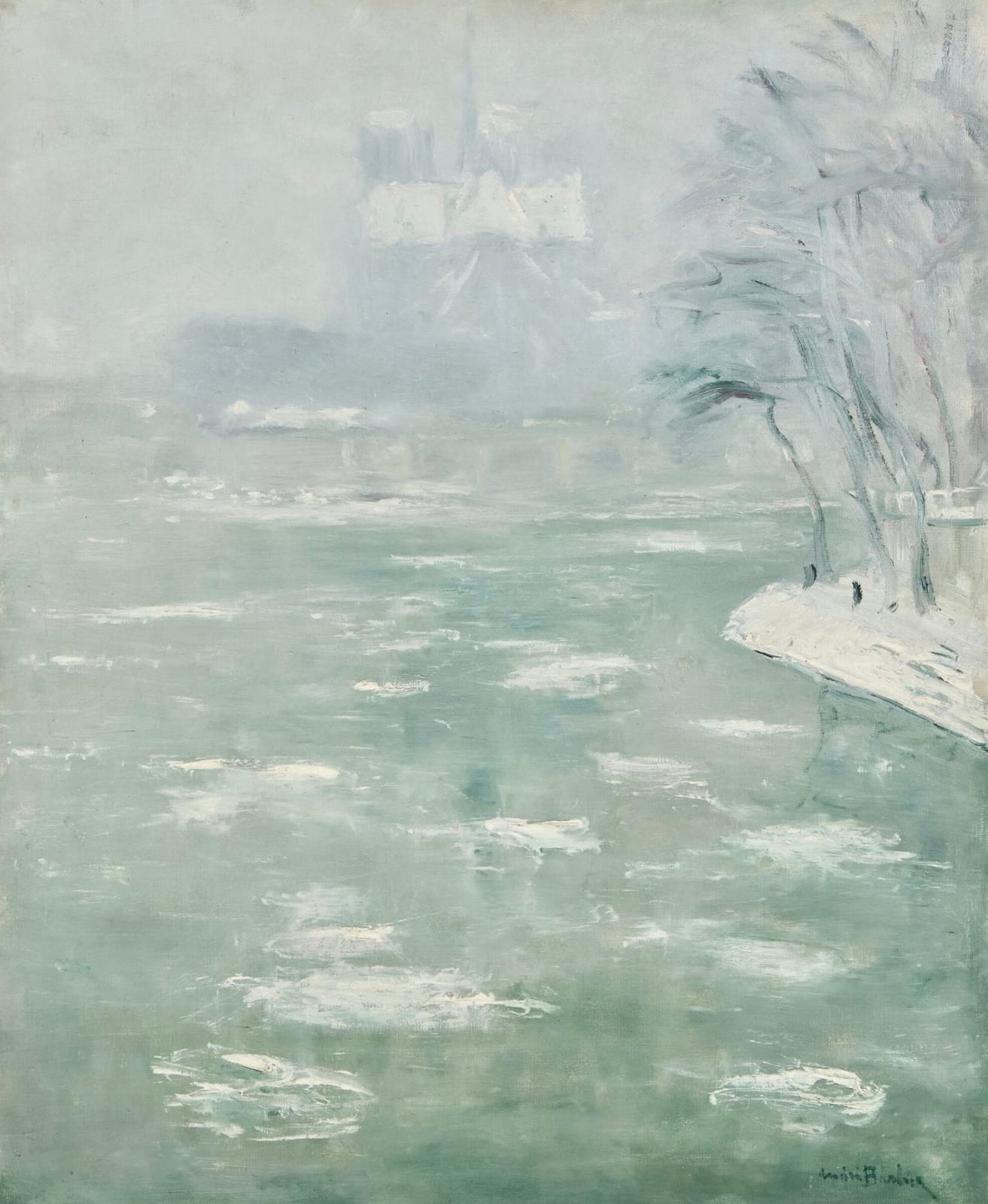
Notre-Dame de Paris sous la NeigeOil on Canvas73 x 60 cms / 28¾ x 23½ inchesSigned 'André Barbier' (lower right)Description
The Seine fills the foreground, its green-grey surface broken by drifting sheets of ice rendered in irregular, pale strokes. On the right, a narrow, snow-covered embankment curves into the picture, lined with slender trees whose dark trunks and sparse branches lean towards the water. Beyond the river, the west front of Notre-Dame emerges through a veil of winter haze. The towers and central façade are softened and partially obscured by the diffused light. The composition is structured around the broad horizontal of the river, countered by the vertical accents of the trees and cathedral towers. Paint is applied in thin, lightly scumbled layers, with thicker touches describing the floating ice. Executed during the artist’s engagement with Parisian river views in winter, Notre-Dame de Paris sous la Neige forms part of a sustained exploration of the city’s monuments under shifting seasonal conditions.
Contact FormSend me more information on André Barbier