-
Overview

Regarded as one of the greatest Belgian painters of the twentieth-century, Modest Huys stands out for his Post-Impressionist landscapes.
Huys sought to capture the luminosity of natural light upon the landscape, which earned him a place in the Vie et Luminière group of predominantly Belgian painters, led by Emile Claus. In 1900, Huys enrolled at The Royal Academy of Fine Arts in Antwerp, where he was taught by Eugène Joors and Frans Van Leemputten. Huys never completed his studies at the Academy, however from the early 1900s he exhibited frequently, revealing the demand for his luminous and ethereal landscapes. From 1905, he participated in the exhibitions of the Vie et Lumière, which had been established by Emile Claus and Théo van Rysselberghe. This group of painters sought to devote their attention to the painting of light effects. Their work is characterised by their skilful use of light within a composition, and in Huys work, in particular, a delicate handling of paint and juxtaposing colours set against bright skys, illuminates the subject and casts a glow over the entire composition.
At the outbreak of the First World War, Huys fled to the Netherlands. His home and studio were destroyed in 1918 and he ended up living with a forester near Brakel in Germany. After the armistice, Huys voluntary exile continued, and he painted scenes of the devastation before settling in Wakken, in Flanders, the following year. In the post war years, Huys began, once again, to exhibit widely. He was a regular exhibitor at the Paris Salon and also in the Unites states, at the Carnegie Institute in Pittsburgh. During this period, Huys’ use of colour became darker and the contrasts harsher, a style approaching expressionism. In 1926, he built his ideal home-studio, the “Zonnehuys” (Sun House), in Zulte in Belgium and remained there fore the rest of his life. Huys was never part of the Brussels’ avante-guarde, but always sought to capture the landscape with the luminosity according to the ideals of the Vie et Luminière.
-
Works
Modest Huys Belgian, 1874-1932
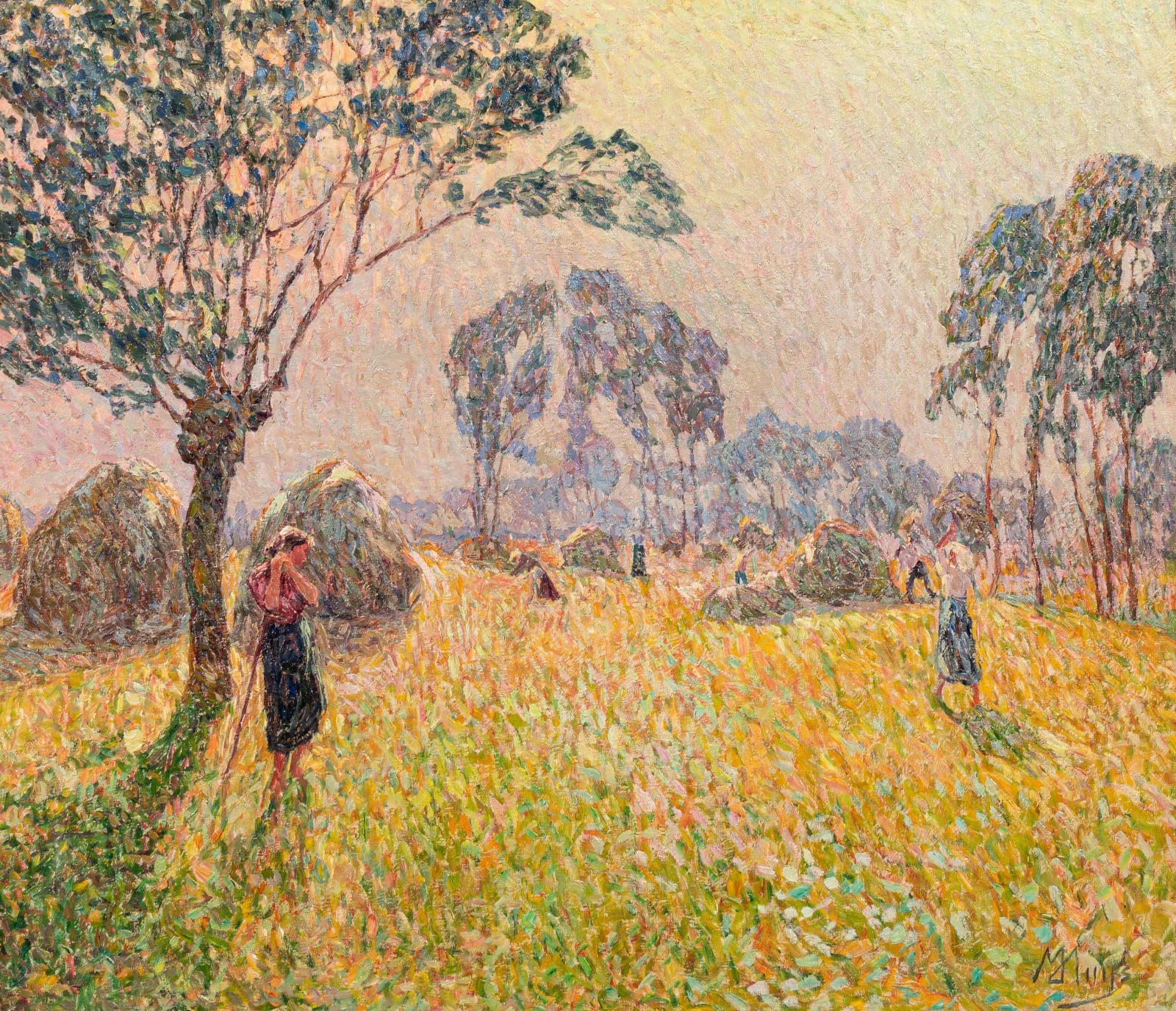
The Harvest, 1912Oil on Canvas71 x 82 cms / 28 x 32¼ inchesSigned ‘M Huys’ (lower right)
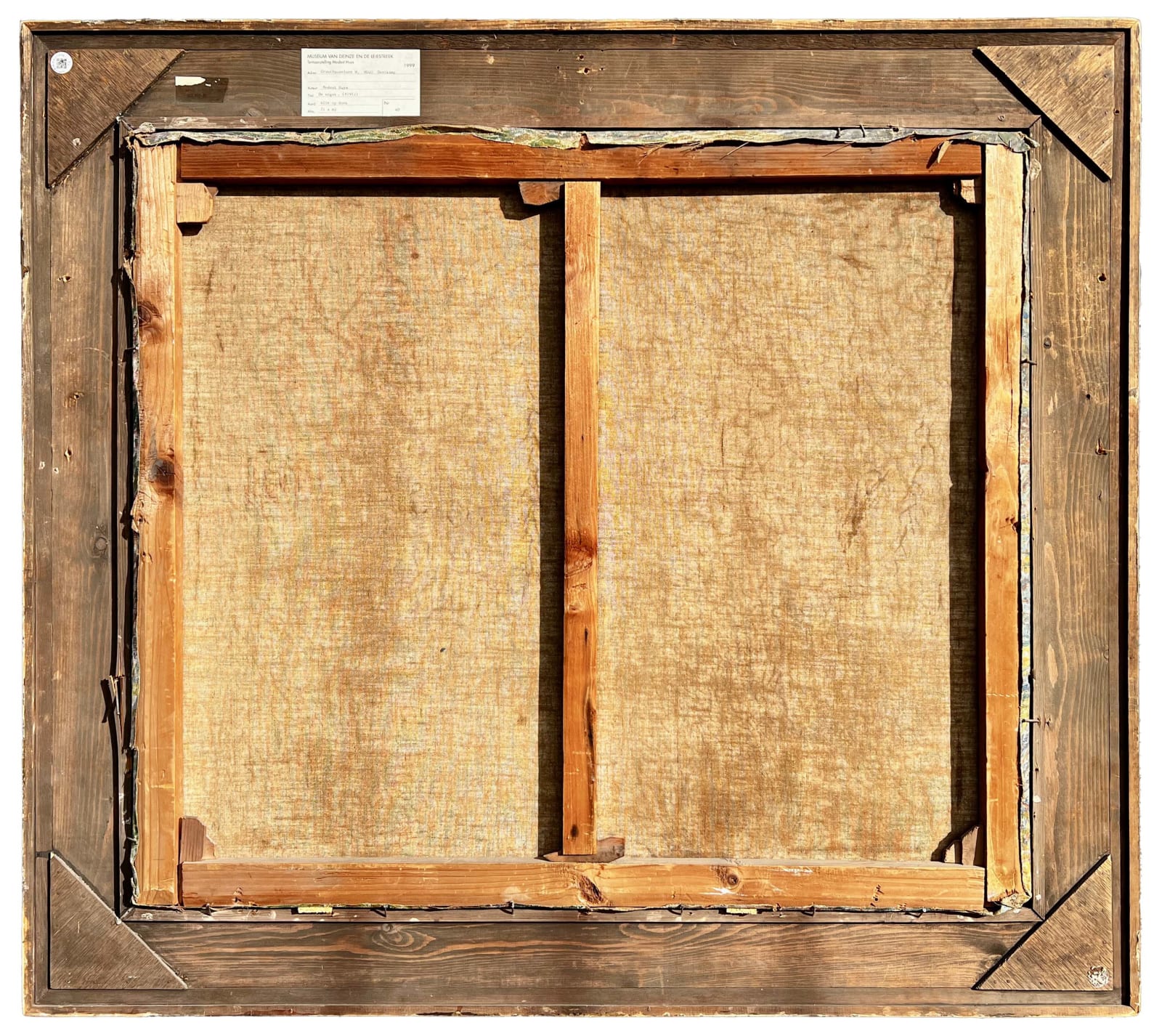
Labelled 'Deinze en de Leiestreek'; 1999 (verso)Price on ApplicationFurther images
Description
The Harvest depicts fieldworkers scattered across a gently rising meadow, haystacks clustered behind them and tall trees breaking the horizon line. Figures are positioned at intervals across the foreground and middle distance, some resting on tools, others lifting bundles of cut grass. Painted during the height of Modest Huys’ career, The Harvest reflects his sustained engagement with rural life around the River Lys. Encouraged by his friendship with the writer Stijn Streuvels, Huys focused on agricultural labour as a serious subject, combining close observation of farm work with a heightened exploration of light and colour. In doing so, he extended Belgian Luminism beyond landscape to encompass the human figures embedded within it.
Provenance
Private Collection, Belgium.
Thence by descent.
Gladwell & Patterson, London; acquired from the above in 2023.
Contact FormSend me more information on Modest Huys