-
Overview
Across Robert's work, familiar locations are approached from unexpected viewpoints, with an emphasis on structure, movement and the observed detail of everyday life.
Robert is a Yorkshire-born artist whose practice encompasses cityscapes, rural landscapes and figurative subjects. He studied at the University of East London before establishing an early career as an architectural illustrator and interior design artist, experience which continues to inform his compositional structure and spatial awareness. He now works as a full-time painter, dividing his time between travel, on-site sketching and studio-based work. He has exhibited regularly at the Royal Academy Summer Exhibition and with the New English Art Club in recent years, where his work has gained consistent recognition. In 2006, he received the President’s Choice Award at the Royal Society of British Artists, followed by the Daler-Rowney Painting Award in 2007. He is a member of the Royal Society of Painters in Oil and the Royal Society of British Artists, and a Fellow of the Chartered Society of Designers.
Working primarily in oils, often using a palette knife, he depicts urban scenes in London, Venice and Naples alongside harbour views and northern landscapes. His compositions are frequently developed from direct observation, with particular attention to light, atmosphere and shifting activity within the scene. His paintings of the Yorkshire Dales and Moors reflect an ongoing engagement with place.
-
Works

Robert E. Wells
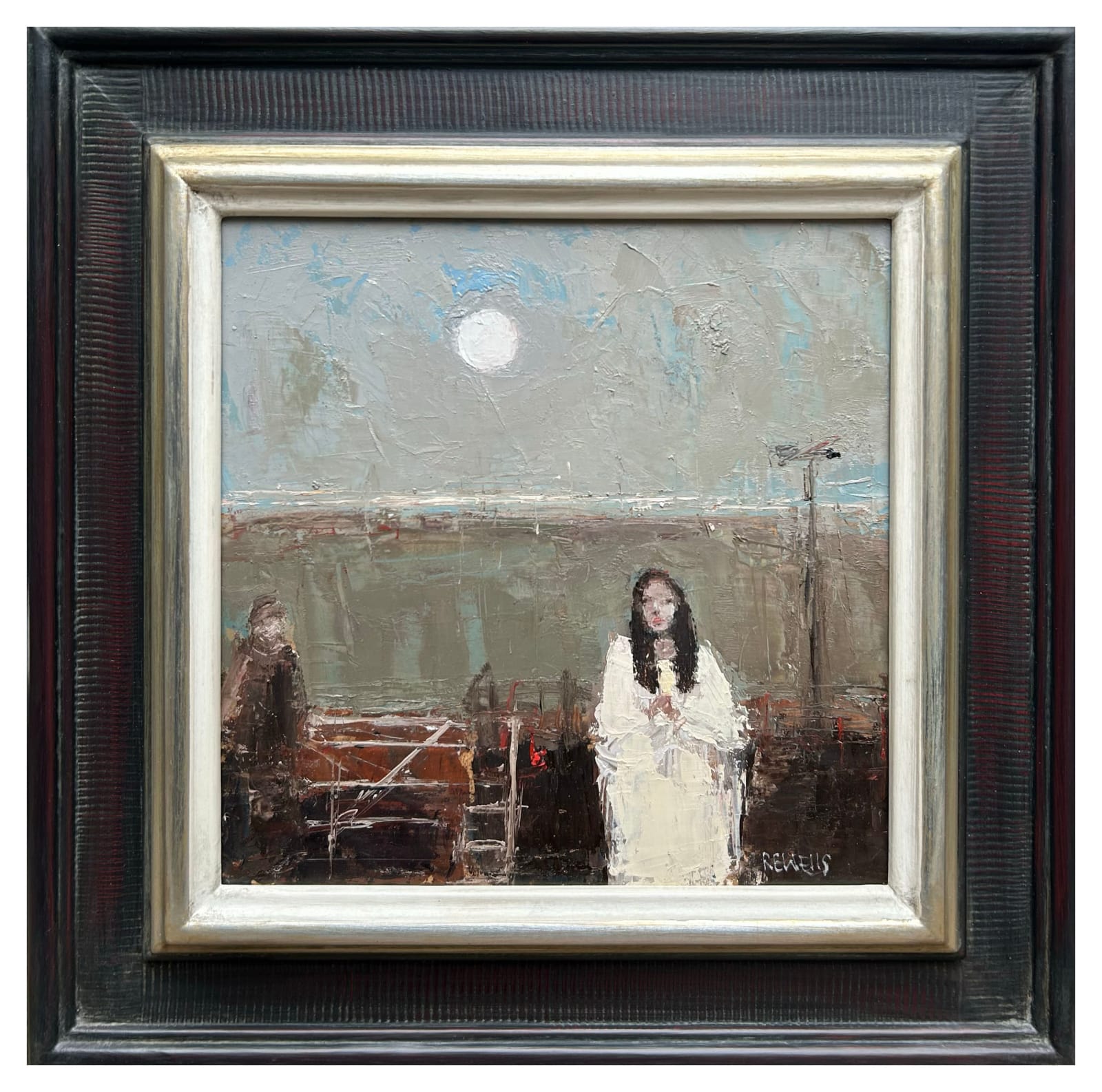
Walking HomeOil on Board21 x 21 cms x 8 x 8 inchesSigned 'R E Wells' (lower right)Further images
Description
Walking Home depicts two loosely articulated figures set within a broad, flattened landscape beneath a pale moon, the ground treated as a continuous expanse of greys, muted blues and softened earth tones. The paint surface is densely worked, with scraped and re-layered passages that blur edges and allow figures and setting to merge. Spatial markers are reduced to essentials: a low horizon, faint linear suggestions of fencing or distant structures and reflective areas across the ground that imply dampness or pooled water. The absence of a defined location is central to the strength of Walking Home. By withholding specific geographic detail, Wells allows the scene to operate as a shared human experience rather than a fixed place. The ambiguity invites personal association, encouraging the viewer to project their own memories of movement.
3of 3Contact FormSend me more information on Robert E. Wells