-
Overview

“I would attribute only one quality to myself: that of being sincere. I work in privacy, when able, and strive to translate as best I can the impressions I receive from nature" - Gustave Loiseau to Thiébault-Sisson, 1930.
With no formal artistic training, Gustave Loiseau shaped his style through the observation of nature and by careful study of his Impressionist forebears. In 1895, Claude Monet and Pierre-Auguste Renoir introduced the young painter to their art dealer Paul Durand-Ruel, who signed an exclusive contract with Loiseau two years later. Under Durand-Ruel's encouragement, and with the financial independence that ensued, Loiseau was able to travel to various landscapes outside Paris, from the Brittany coastline at Pont-Aven, to the small picturesque towns along the River Seine and the River Yonne. In his later years, Loiseau continued to travel widely and spent a great deal of time in Paris where he had a studio on the Quai d'Anjou on the Île Saint-Louis, the adjacent island on the Seine to that of Notre-Dame. During the summer months, Loiseau would travel extensively to Normandy, Brittany and the picturesque river towns where he spent his youth. His later years are characterised by the systematic exploration of a series of views of the same subject, a method deeply indebted to Monet. Focused upon a single compositional device, the artist thoroughly investigated the different atmospheric conditions of one view point or landscape, capturing his subjects in contrasting seasons. Loiseau was a champion of painting the landscape 'en plein air'. In his quest to create movement and light, in his mature years Loiseau developed a distinct 'cross hatching' technique, called 'en treillis', which resulted in the supple and ephemeral quality for which his work is known. These later works, characterised by a homogeneous and yet vibrating colour structure formed through staccato-like brushwork, was developed from Loiseau's influence of the pointillism of Seurat and Signac. Identifiable through a rich surface, composed using spontaneous brushwork as the pigment is layered upon the canvas, Loiseau's later works reveal the artists experimental nature in his quest to capture nature as he experienced it.
-
Works
Gustave Loiseau French, 1865-1935
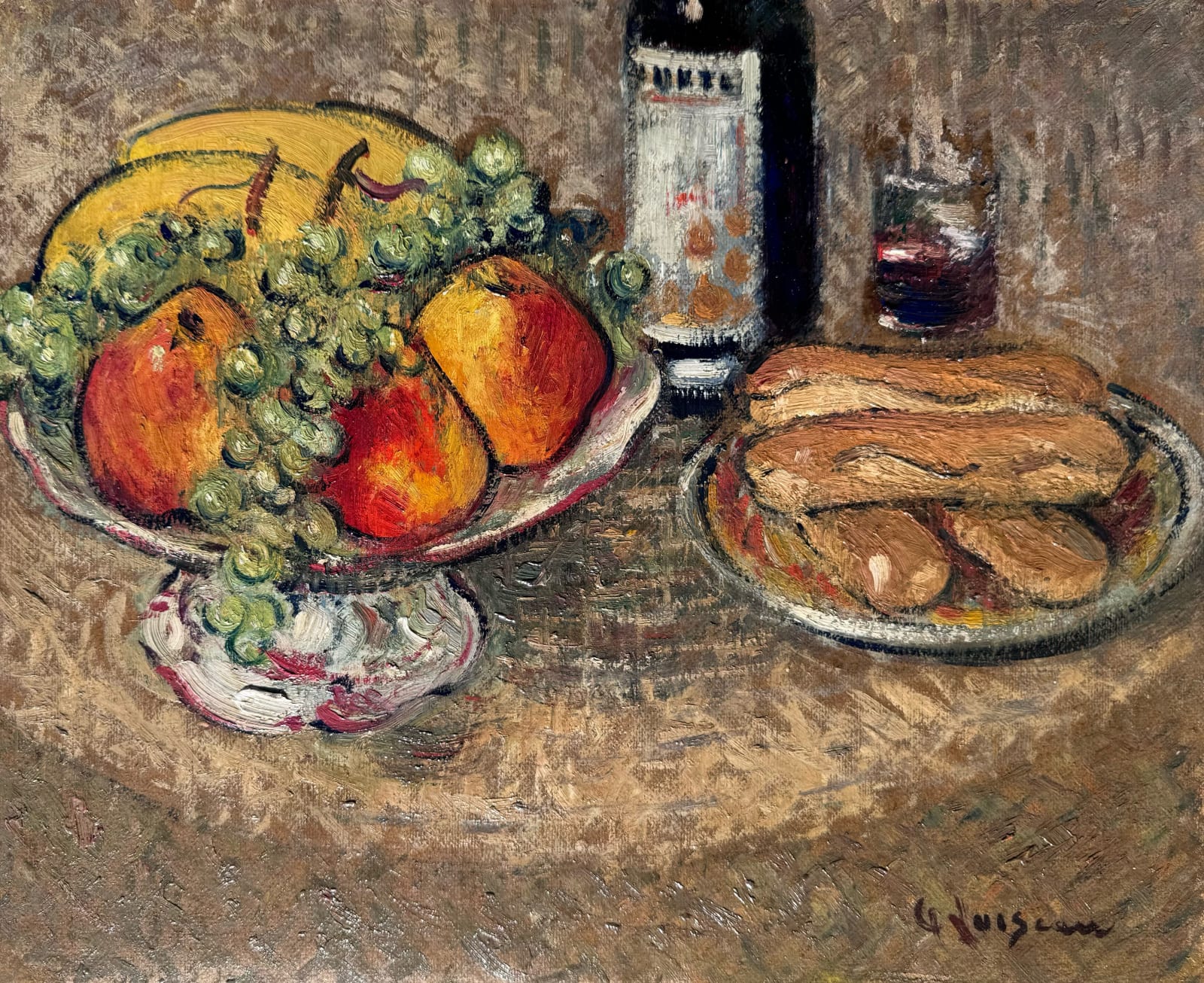
Nature Morte aux Fruits, Circa 1922Oil on Board38.5 x 47.5 cms / 15¼ x 18¾ inchesSigned lower right 'G. Loiseau'Description
Nature Morte aux Fruits, painted in 1922, is a rare and fascinating testament to the enduring influence of Paul Gauguin on Loiseau’s work. Although Loiseau is primarily celebrated for his evocative en plein air landscapes, his still lifes reflect a deep compositional understanding honed during his formative years in Pont-Aven in the 1890s under Gauguin’s leadership. The painting itself is an exquisite interplay of texture and colour. To understand the influence of Gauguin upon this painting and the still life genre within Loiseau’s oeuvre, we must return to the very early years of Loiseau’s career. In May 1890, encouraged by the French landscape painter Fernand Quignon, the young artist travelled to Pont-Aven in Brittany to join the famous artists’ colony there. The picturesque village of Pont-Aven in the Finistère department of Brittany attracted artists wanting to spend their summers away from the stifling heat of the city. Largely untouched by tourism, Pont-Aven offered affordable accommodation to this group of artists who were drawn to the beauty of the surrounding countryside. The Pont-Aven School soon developed an international reputation with artists enticed by the unique Bretagne characteristics of the natives and the landscape.
1of 5Contact FormSend me more information on Gustave Loiseau